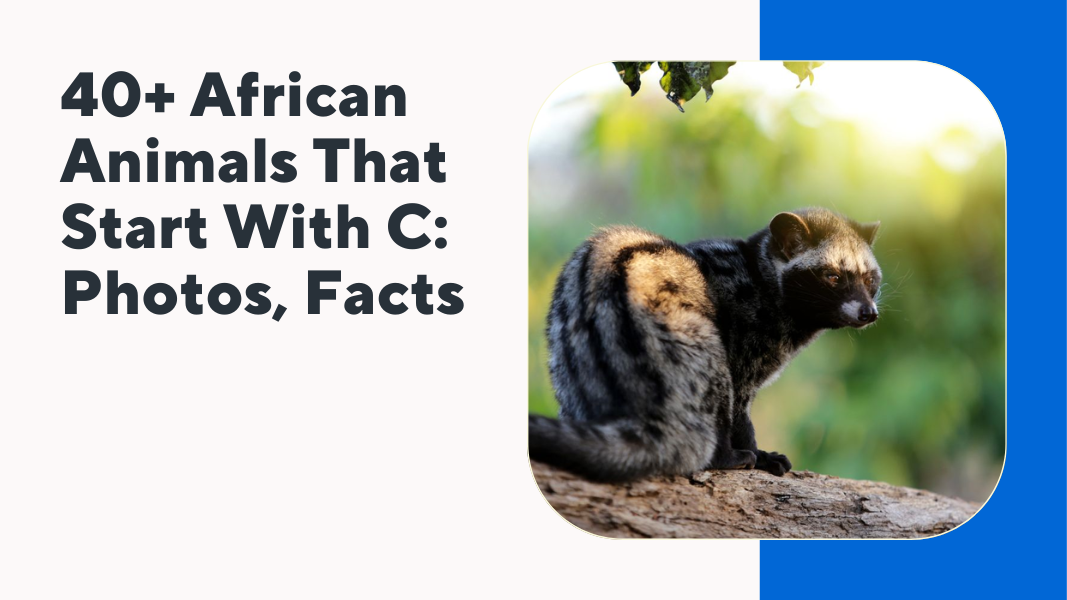
40+ African Animals That Start With C: Photos, Facts
Africa hosts one of the planet’s richest collections of wildlife, shaped by vast deserts, savannas, rainforests, rivers, and coastlines. This article explores african animals that start with c, bringing together species from multiple animal groups so readers can compare how mammals, birds, reptiles, and fish adapt to very different environments.
You’ll find big predators and tiny specialists, land dwellers and aquatic survivors, each with unique behaviors and ecological roles. To keep things clear and educational, animals are grouped by shared traits and presented with concise descriptions, standardized measurements, and conservation status. Whether you’re researching for school, planning a safari, or simply curious about biodiversity, this guide aims to be accurate, accessible, and engaging—celebrating both famous icons and lesser-known species that deserve attention.
African Animals That Start With C
Camel (Dromedary) (Camelus dromedarius)
The dromedary camel inhabits arid and semi-arid regions of North Africa, thriving where water is scarce. It has a single hump that stores fat, helping it survive long periods without drinking. Adults are tall and long-legged, built for walking across hot sand. Their diet includes dry grasses, shrubs, and thorny plants. Socially, camels often move in herds led by a dominant male. Fun Fact: A dromedary can drink over 100 liters of water in minutes after dehydration.
Quick Facts Table
| Attribute | Detail |
|---|---|
| Size | 1.8–2.0 m; 5.9–6.6 ft |
| Weight | 400–600 kg; 880–1,320 lb |
| Lifespan | 40–50 years |
| Habitat | Deserts, semi-arid plains |
| Diet | Grasses, shrubs |
| Social Structure | Herds |
| Conservation | Least Concern |
Fun Fact: Their thick eyelashes protect eyes from blowing sand.
Cape Buffalo (Syncerus caffer)
Cape buffalo roam sub-Saharan Africa in grasslands and woodlands near water. They are heavily built with massive curved horns forming a protective boss. Grazing on grasses, they move in large herds that provide safety from predators. Buffalo are known for unpredictable behavior and strong herd defense. Despite their size, they can run surprisingly fast. Fun Fact: Herds will collectively defend calves against lions.
Quick Facts Table
| Attribute | Detail |
|---|---|
| Size | 1.4–1.7 m; 4.6–5.6 ft |
| Weight | 500–900 kg; 1,100–1,980 lb |
| Lifespan | 15–25 years |
| Habitat | Savannas, woodlands |
| Diet | Grasses |
| Social Structure | Large herds |
| Conservation | Least Concern |
Fun Fact: Old males form bachelor groups called “dagga boys.”
Caracal (Caracal caracal)
The caracal is a medium-sized wild cat found across Africa’s dry regions. It has a sleek reddish coat and distinctive black ear tufts. An agile hunter, it preys on birds, rodents, and small antelope. Caracals are mostly solitary and active at night. They adapt well to varied habitats from savanna to semi-desert. Fun Fact: A caracal can leap three meters to snatch birds mid-air.
Quick Facts Table
| Attribute | Detail |
|---|---|
| Size | 40–50 cm; 16–20 in |
| Weight | 8–19 kg; 18–42 lb |
| Lifespan | 12–15 years |
| Habitat | Savannas, deserts |
| Diet | Small mammals, birds |
| Social Structure | Solitary |
| Conservation | Least Concern |
Fun Fact: Ear tufts aid communication and hunting focus.
Cheetah (Acinonyx jubatus)
Cheetahs inhabit open plains where speed is essential for survival. Their slim bodies, long legs, and spotted coats make them Africa’s fastest land animals. They hunt mainly during the day, targeting gazelles and other small antelope. Unlike other big cats, cheetahs rely on speed rather than strength. Cubs face high predation risk in the wild. Fun Fact: A cheetah can accelerate from 0 to 96 km/h in about three seconds.
Quick Facts Table
| Attribute | Detail |
|---|---|
| Size | 67–94 cm; 26–37 in |
| Weight | 21–72 kg; 46–159 lb |
| Lifespan | 10–12 years |
| Habitat | Grasslands |
| Diet | Antelope |
| Social Structure | Solitary or small groups |
| Conservation | Vulnerable |
Fun Fact: Semi-retractable claws improve traction at high speed.
Chimpanzee (Pan troglodytes)
Chimpanzees live in tropical forests and savannas of Central and West Africa. They are highly intelligent, using tools to access food like termites and nuts. Their diet is omnivorous, including fruit, leaves, insects, and meat. Chimpanzees form complex social groups with strong bonds. Communication includes vocalizations, gestures, and facial expressions. Fun Fact: Chimpanzees share about 98 percent of their DNA with humans.
Quick Facts Table
| Attribute | Detail |
|---|---|
| Size | 1.0–1.7 m; 3.3–5.6 ft |
| Weight | 26–70 kg; 57–154 lb |
| Lifespan | 33–40 years |
| Habitat | Forests, savannas |
| Diet | Omnivorous |
| Social Structure | Communities |
| Conservation | Endangered |
Fun Fact: They make fishing sticks to catch termites.
Colobus Monkey (Colobus guereza)
Colobus monkeys inhabit African forests and riverine woodlands. They are known for striking black-and-white fur and long tails. Their specialized stomachs digest leaves efficiently. Groups move through treetops with impressive agility. They rarely descend to the ground. Fun Fact: Colobus monkeys lack thumbs, aiding swift movement in trees.
Quick Facts Table
| Attribute | Detail |
|---|---|
| Size | 45–72 cm; 18–28 in |
| Weight | 7–14 kg; 15–31 lb |
| Lifespan | 20–25 years |
| Habitat | Forests |
| Diet | Leaves, fruit |
| Social Structure | Troops |
| Conservation | Least Concern |
Fun Fact: Their tails act as balance rudders.
Common Genet (Genetta genetta)
Common genets are nocturnal mammals found across much of Africa. They have slender bodies, spotted coats, and long ringed tails. Skilled climbers, they hunt rodents, birds, and insects. Genets are solitary and secretive. They adapt well to human-altered landscapes. Fun Fact: Despite cat-like looks, genets belong to the civet family.
Quick Facts Table
| Attribute | Detail |
|---|---|
| Size | 43–55 cm; 17–22 in |
| Weight | 1–3 kg; 2.2–6.6 lb |
| Lifespan | 13–20 years |
| Habitat | Woodlands |
| Diet | Small animals |
| Social Structure | Solitary |
| Conservation | Least Concern |
Fun Fact: Their tails help with night balance.
Common Eland (Taurotragus oryx)
The common eland is Africa’s largest antelope, inhabiting savannas and plains. It has a robust body with faint vertical stripes. Elands feed on grasses and browse shrubs. They can leap over two meters despite their size. Herds migrate seasonally following rainfall. Fun Fact: Elands can survive without drinking water for long periods.
Quick Facts Table
| Attribute | Detail |
|---|---|
| Size | 1.4–1.8 m; 4.6–5.9 ft |
| Weight | 400–900 kg; 880–1,980 lb |
| Lifespan | 20–25 years |
| Habitat | Savannas |
| Diet | Grasses, leaves |
| Social Structure | Herds |
| Conservation | Least Concern |
Fun Fact: Their joints make clicking sounds while walking.
Crowned Eagle (Stephanoaetus coronatus)
Crowned eagles inhabit dense African forests. They are powerful raptors with striking crests and strong talons. Hunting monkeys and small antelope, they rely on stealth and strength. Pairs maintain large territories. They nest high in tall trees. Fun Fact: Crowned eagles can lift prey nearly their own weight.
Quick Facts Table
| Attribute | Detail |
|---|---|
| Size | 80–99 cm; 31–39 in |
| Weight | 3–4.7 kg; 6.6–10.4 lb |
| Lifespan | 14–15 years |
| Habitat | Forests |
| Diet | Mammals |
| Social Structure | Pairs |
| Conservation | Near Threatened |
Fun Fact: They are among Africa’s most powerful eagles.
Nile Crocodile (Crocodylus niloticus)
Nile crocodiles inhabit rivers and lakes across Africa. They are massive reptiles with armored skin and powerful jaws. Feeding on fish, birds, and mammals, they are apex predators. Crocodiles bask to regulate body temperature. Females guard nests fiercely. Fun Fact: Nile crocodiles can hold their breath underwater for over an hour.
Quick Facts Table
| Attribute | Detail |
|---|---|
| Size | 3–5 m; 9.8–16.4 ft |
| Weight | 225–750 kg; 496–1,653 lb |
| Lifespan | 70–100 years |
| Habitat | Rivers, lakes |
| Diet | Carnivorous |
| Social Structure | Solitary |
| Conservation | Least Concern |
Fun Fact: Their bite force is among the strongest of any animal.
Cuvier’s Beaked Whale (Ziphius cavirostris)
Cuvier’s beaked whale is a deep-diving marine mammal found off Africa’s Atlantic and Indian Ocean coasts. It has a robust, torpedo-shaped body with a short beak and pale scars from squid encounters. This species feeds primarily on deep-sea squid and fish. It is known for record-breaking dives lasting over two hours. Sightings are rare due to its offshore habits. Fun Fact: This whale holds the record for the deepest dive by a mammal.
Quick Facts Table
| Attribute | Detail |
|---|---|
| Size | 6–7 m; 19.7–23 ft |
| Weight | 2,500–3,000 kg; 5,500–6,600 lb |
| Lifespan | 50–60 years |
| Habitat | Deep ocean waters |
| Diet | Squid, fish |
| Social Structure | Small groups |
| Conservation | Least Concern |
Fun Fact: Scars on males come from tooth-raking battles.
Cape Porcupine (Hystrix africaeaustralis)
The Cape porcupine is Africa’s largest rodent, living in savannas, deserts, and woodlands. It has long black-and-white quills used for defense. Mostly nocturnal, it forages for roots, tubers, and bark. Porcupines live in family groups sharing burrows. They are strong diggers and highly adaptable. Fun Fact: Quills do not shoot out but detach easily when touched.
Quick Facts Table
| Attribute | Detail |
|---|---|
| Size | 60–83 cm; 24–33 in |
| Weight | 10–30 kg; 22–66 lb |
| Lifespan | 15–20 years |
| Habitat | Savannas, deserts |
| Diet | Roots, bark |
| Social Structure | Family groups |
| Conservation | Least Concern |
Fun Fact: Their quills can regrow after loss.
Common Duiker (Sylvicapra grimmia)
The common duiker is a small antelope widespread across sub-Saharan Africa. It inhabits woodlands, savannas, and scrublands. Duikers are shy and usually solitary, darting into cover when threatened. Their diet includes leaves, fruit, and occasionally insects. They are active mainly at dawn and dusk. Fun Fact: The name “duiker” comes from an Afrikaans word meaning “diver.”
Quick Facts Table
| Attribute | Detail |
|---|---|
| Size | 50–58 cm; 20–23 in |
| Weight | 12–25 kg; 26–55 lb |
| Lifespan | 8–12 years |
| Habitat | Woodlands |
| Diet | Leaves, fruit |
| Social Structure | Solitary |
| Conservation | Least Concern |
Fun Fact: They freeze briefly before sudden escape leaps.
Common Ostrich (Struthio camelus)
The common ostrich roams open plains and deserts of Africa. It is the world’s largest living bird, incapable of flight but extremely fast on land. Ostriches feed on plants, seeds, and insects. They live in loose groups and share nesting duties. Powerful legs provide both speed and defense. Fun Fact: An ostrich can run up to 70 km/h.
Quick Facts Table
| Attribute | Detail |
|---|---|
| Size | 2.1–2.8 m; 6.9–9.2 ft |
| Weight | 90–150 kg; 198–331 lb |
| Lifespan | 30–40 years |
| Habitat | Savannas, deserts |
| Diet | Omnivorous |
| Social Structure | Groups |
| Conservation | Least Concern |
Fun Fact: Their eyes are larger than their brains.
Common Reedbuck (Redunca arundinum)
Common reedbucks live near wetlands and grasslands across Africa. They have soft gray-brown coats and males bear curved horns. Grazing mainly on grasses, they prefer areas near water. Reedbucks are mostly solitary or found in pairs. When alarmed, they emit a high-pitched whistle. Fun Fact: Their whistle serves as a warning to others nearby.
Quick Facts Table
| Attribute | Detail |
|---|---|
| Size | 80–90 cm; 31–35 in |
| Weight | 35–95 kg; 77–209 lb |
| Lifespan | 10–12 years |
| Habitat | Grasslands, wetlands |
| Diet | Grasses |
| Social Structure | Solitary or pairs |
| Conservation | Least Concern |
Fun Fact: They rest in tall grass during the day.
Common Warthog (Phacochoerus africanus)
The common warthog inhabits African savannas and grasslands. It has a sturdy body, large tusks, and facial “warts.” Warthogs graze on grasses and dig for roots. They often kneel on front knees while feeding. Family groups share burrows for shelter. Fun Fact: Warthogs can run with tails held upright like flags.
Quick Facts Table
| Attribute | Detail |
|---|---|
| Size | 65–85 cm; 26–33 in |
| Weight | 50–150 kg; 110–331 lb |
| Lifespan | 12–15 years |
| Habitat | Savannas |
| Diet | Grasses, roots |
| Social Structure | Family groups |
| Conservation | Least Concern |
Fun Fact: They reverse into burrows for quick escapes.
Common Zebra (Equus quagga)
Common zebras roam grasslands and savannas in eastern and southern Africa. Their bold black-and-white stripes are unique to each individual. Zebras graze primarily on grasses. They form stable family groups within larger herds. Strong social bonds help protect against predators. Fun Fact: Zebra stripes may deter biting insects.
Quick Facts Table
| Attribute | Detail |
|---|---|
| Size | 1.2–1.4 m; 3.9–4.6 ft |
| Weight | 200–380 kg; 441–838 lb |
| Lifespan | 20–30 years |
| Habitat | Grasslands |
| Diet | Grasses |
| Social Structure | Harems |
| Conservation | Near Threatened |
Fun Fact: Each zebra’s stripe pattern is unique.
Crested Porcupine (Hystrix cristata)
Crested porcupines inhabit forests and rocky areas of North Africa. They have impressive crests of long quills raised when threatened. Nocturnal by nature, they feed on roots, bulbs, and fallen fruit. They live in small family groups. Their presence helps soil aeration through digging. Fun Fact: Crested porcupines have been known to chew bones for minerals.
Quick Facts Table
| Attribute | Detail |
|---|---|
| Size | 60–90 cm; 24–35 in |
| Weight | 10–27 kg; 22–60 lb |
| Lifespan | 12–15 years |
| Habitat | Forests, rocky hills |
| Diet | Roots, bulbs |
| Social Structure | Family groups |
| Conservation | Least Concern |
Fun Fact: Their quills can rattle loudly as warning.
Cattle Egret (Bubulcus ibis)
Cattle egrets are widespread across Africa’s grasslands and wetlands. They are small white herons often seen near grazing animals. Feeding on insects disturbed by livestock, they benefit from human agriculture. Egrets nest colonially in trees near water. Their populations have expanded globally. Fun Fact: They often perch on large mammals to catch insects.
Quick Facts Table
| Attribute | Detail |
|---|---|
| Size | 46–56 cm; 18–22 in |
| Weight | 270–512 g; 0.6–1.1 lb |
| Lifespan | 15–20 years |
| Habitat | Grasslands, wetlands |
| Diet | Insects |
| Social Structure | Colonies |
| Conservation | Least Concern |
Fun Fact: They follow tractors as readily as cattle.
Clarias Catfish (Clarias gariepinus)
The Clarias catfish inhabits rivers, lakes, and floodplains across Africa. It has an elongated body and barbels for sensing prey. This fish can breathe air, allowing survival in low-oxygen waters. It feeds on fish, insects, and plant matter. During droughts, it can wriggle short distances over land. Fun Fact: This catfish can survive out of water for hours.
Quick Facts Table
| Attribute | Detail |
|---|---|
| Size | 1–1.7 m; 3.3–5.6 ft |
| Weight | 20–60 kg; 44–132 lb |
| Lifespan | 8–15 years |
| Habitat | Rivers, lakes |
| Diet | Omnivorous |
| Social Structure | Solitary |
| Conservation | Least Concern |
Fun Fact: It is widely farmed for food.
Crowned Crane (Balearica regulorum)
The crowned crane inhabits wetlands and grasslands across eastern and southern Africa. It is easily recognized by its golden crown of stiff feathers and elegant posture. These cranes feed on seeds, insects, small reptiles, and amphibians. They often forage in pairs or small family groups. Crowned cranes perform elaborate courtship dances involving jumps and wing displays. Fun Fact: It is the national bird of Uganda.
Quick Facts Table
| Attribute | Detail |
|---|---|
| Size | 100–110 cm; 39–43 in |
| Weight | 3–4 kg; 6.6–8.8 lb |
| Lifespan | 20–25 years |
| Habitat | Wetlands, grasslands |
| Diet | Omnivorous |
| Social Structure | Pairs, small groups |
| Conservation | Endangered |
Fun Fact: They can roost in trees, unlike most cranes.
Cape Vulture (Gyps coprotheres)
Cape vultures are found in southern Africa, nesting on rocky cliffs. They have broad wings adapted for soaring long distances in search of carrion. Feeding exclusively on carcasses, they play a vital role in disease control. Cape vultures breed colonially and raise a single chick. Their populations are declining due to poisoning and power-line collisions. Fun Fact: Their wingspan can exceed 2.6 meters.
Quick Facts Table
| Attribute | Detail |
|---|---|
| Size | 95–115 cm; 37–45 in |
| Weight | 7–11 kg; 15–24 lb |
| Lifespan | 25–30 years |
| Habitat | Cliffs, open plains |
| Diet | Carrion |
| Social Structure | Colonies |
| Conservation | Endangered |
Fun Fact: They can glide for hours without flapping.
Cape Fox (Vulpes chama)
The Cape fox inhabits dry savannas and semi-deserts of southern Africa. It has large ears that help regulate body temperature and detect prey. Nocturnal by nature, it feeds on insects, rodents, and fruit. Cape foxes are mostly solitary or found in pairs. They use burrows for shelter during the day. Fun Fact: Its large ears also enhance hearing in low-light hunting.
Quick Facts Table
| Attribute | Detail |
|---|---|
| Size | 30–40 cm; 12–16 in |
| Weight | 2.5–4.5 kg; 5.5–9.9 lb |
| Lifespan | 10–12 years |
| Habitat | Semi-deserts, savannas |
| Diet | Omnivorous |
| Social Structure | Solitary or pairs |
| Conservation | Least Concern |
Fun Fact: Cape foxes rarely need free-standing water.
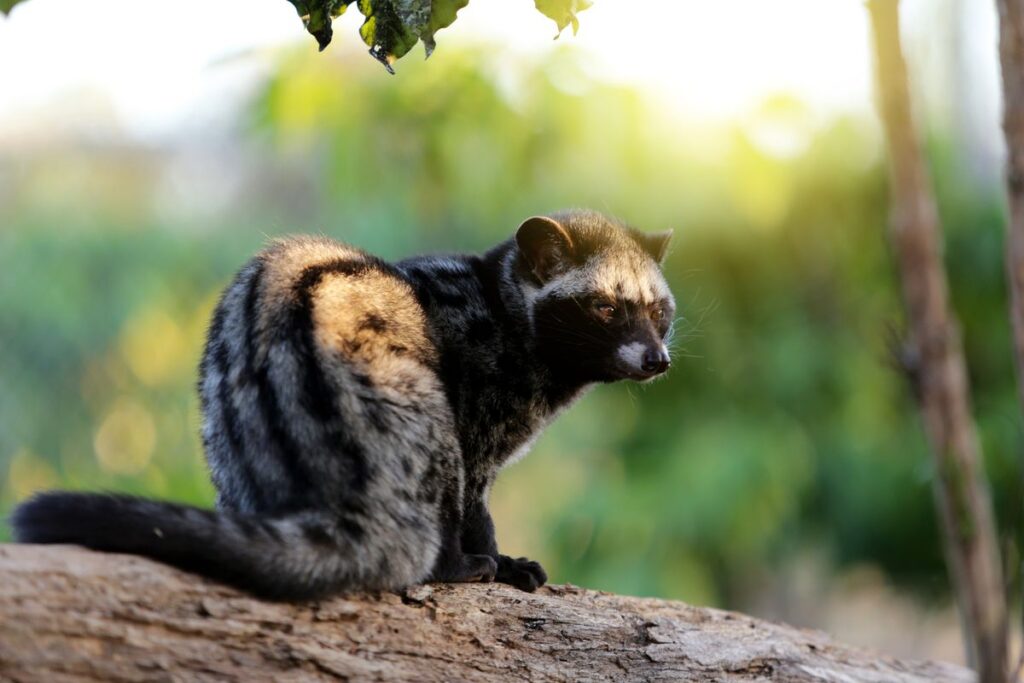
Civet (Civettictis civetta)
African civets live in forests and savannas across sub-Saharan Africa. They have coarse fur with bold black-and-white markings. Civets are nocturnal omnivores feeding on fruit, insects, and small animals. They are solitary and highly territorial. Civets are known for producing a musky secretion used historically in perfumes. Fun Fact: Civets help disperse seeds through their droppings.
Quick Facts Table
| Attribute | Detail |
|---|---|
| Size | 67–84 cm; 26–33 in |
| Weight | 7–20 kg; 15–44 lb |
| Lifespan | 15–20 years |
| Habitat | Forests, savannas |
| Diet | Omnivorous |
| Social Structure | Solitary |
| Conservation | Least Concern |
Fun Fact: Their scent glands are used for territory marking.
Cape Hyrax (Procavia capensis)
Cape hyraxes inhabit rocky outcrops and cliffs across Africa. Though small, they are closely related to elephants. Hyraxes feed on grasses and leaves, often basking in the sun. They live in colonies with complex social communication. Sharp calls warn of predators overhead. Fun Fact: Hyrax feet have rubbery pads for gripping rocks.
Quick Facts Table
| Attribute | Detail |
|---|---|
| Size | 30–55 cm; 12–22 in |
| Weight | 2–5 kg; 4.4–11 lb |
| Lifespan | 10–12 years |
| Habitat | Rocky hills |
| Diet | Herbivorous |
| Social Structure | Colonies |
| Conservation | Least Concern |
Fun Fact: They sunbathe to regulate body temperature.
Cape Gannet (Morus capensis)
Cape gannets breed along southern Africa’s coastline. They are large seabirds with white bodies and black-tipped wings. Feeding mainly on fish, they plunge-dive from great heights. Gannets nest in dense colonies on offshore islands. Their populations depend heavily on fish availability. Fun Fact: They can dive at speeds over 100 km/h.
Quick Facts Table
| Attribute | Detail |
|---|---|
| Size | 90–100 cm; 35–39 in |
| Weight | 2.3–3.6 kg; 5–8 lb |
| Lifespan | 20–25 years |
| Habitat | Coastal islands |
| Diet | Fish |
| Social Structure | Colonies |
| Conservation | Endangered |
Fun Fact: Their streamlined bodies reduce impact during dives.
Cliff Swallow (Petrochelidon spilodera)
Cliff swallows inhabit cliffs and human structures across parts of Africa. They build gourd-shaped mud nests in large colonies. Feeding on flying insects, they forage in open airspace. Swallows migrate seasonally following insect abundance. Their nesting colonies can number in the thousands. Fun Fact: One colony may include hundreds of interconnected nests.
Quick Facts Table
| Attribute | Detail |
|---|---|
| Size | 13–15 cm; 5–6 in |
| Weight | 20–25 g; 0.7–0.9 oz |
| Lifespan | 6–8 years |
| Habitat | Cliffs, buildings |
| Diet | Insects |
| Social Structure | Colonies |
| Conservation | Least Concern |
Fun Fact: They reuse nests year after year.
Corn Snake (African populations) (Pantherophis guttatus)
Corn snakes are occasionally found in parts of northern Africa through introductions. They are slender snakes with patterned scales. Feeding mainly on rodents, they help control pest populations. Corn snakes are non-venomous and docile. They are mostly nocturnal and secretive. Fun Fact: Their name comes from frequent sightings near grain stores.
Quick Facts Table
| Attribute | Detail |
|---|---|
| Size | 1.2–1.8 m; 3.9–5.9 ft |
| Weight | 0.5–1 kg; 1.1–2.2 lb |
| Lifespan | 15–20 years |
| Habitat | Grasslands, farms |
| Diet | Rodents |
| Social Structure | Solitary |
| Conservation | Least Concern |
Fun Fact: They kill prey by constriction.
Corydoras Catfish (Corydoras spp.)
Corydoras catfish inhabit slow-moving African freshwater systems. They are small fish with bony armor plates. Feeding on detritus and small invertebrates, they help clean riverbeds. Corydoras are social, often forming schools. They can gulp air from the surface. Fun Fact: They breathe partly through their intestines.
Quick Facts Table
| Attribute | Detail |
|---|---|
| Size | 2–7 cm; 0.8–2.8 in |
| Weight | <0.1 kg; <0.2 lb |
| Lifespan | 5–10 years |
| Habitat | Freshwater rivers |
| Diet | Invertebrates |
| Social Structure | Schools |
| Conservation | Least Concern |
Fun Fact: Popular in aquariums worldwide.
Cuckoo (Cuculus spp.)
African cuckoos inhabit forests and woodlands. They are slender birds known for brood parasitism. Females lay eggs in other birds’ nests. Cuckoos feed on insects, especially caterpillars. Their calls are distinctive and far-carrying. Fun Fact: Host birds often raise cuckoo chicks unknowingly.
Quick Facts Table
| Attribute | Detail |
|---|---|
| Size | 32–34 cm; 13–14 in |
| Weight | 100–130 g; 3.5–4.6 oz |
| Lifespan | 6–10 years |
| Habitat | Forests |
| Diet | Insects |
| Social Structure | Solitary |
| Conservation | Least Concern |
Fun Fact: Some species mimic host egg colors.
Cape Cobra (Naja nivea)
The Cape cobra is a highly venomous snake found in southern Africa’s dry savannas and semi-deserts. It has a smooth body that varies in color from yellow to dark brown. This species preys on rodents, birds, and other reptiles. Cape cobras are alert and may raise a hood when threatened. They are mostly diurnal and often shelter in abandoned burrows. Fun Fact: Cape cobras are excellent climbers and swimmers.
Quick Facts Table
| Attribute | Detail |
|---|---|
| Size | 1.2–1.6 m; 3.9–5.2 ft |
| Weight | 1–2 kg; 2.2–4.4 lb |
| Lifespan | 12–20 years |
| Habitat | Savannas, deserts |
| Diet | Rodents, birds |
| Social Structure | Solitary |
| Conservation | Least Concern |
Fun Fact: Their venom is primarily neurotoxic.
Cape Pangolin (Smutsia temminckii)
The Cape pangolin inhabits savannas and grasslands of southern and eastern Africa. It is covered in protective keratin scales that shield it from predators. Pangolins feed almost exclusively on ants and termites using long sticky tongues. They are nocturnal and solitary by nature. When threatened, they roll into a tight ball. Fun Fact: Pangolins have no teeth.
Quick Facts Table
| Attribute | Detail |
|---|---|
| Size | 60–90 cm; 24–35 in |
| Weight | 8–21 kg; 18–46 lb |
| Lifespan | 15–20 years |
| Habitat | Savannas |
| Diet | Ants, termites |
| Social Structure | Solitary |
| Conservation | Vulnerable |
Fun Fact: Their scales are made of keratin like human nails.
Crested Francolin (Dendroperdix sephaena)
Crested francolins are ground-dwelling birds found in African savannas and woodlands. They have mottled brown plumage that provides camouflage. Feeding on seeds, insects, and shoots, they forage mostly on the ground. Francolins live in pairs or small family groups. Their loud calls are common at dawn. Fun Fact: They run swiftly when disturbed instead of flying.
Quick Facts Table
| Attribute | Detail |
|---|---|
| Size | 30–35 cm; 12–14 in |
| Weight | 300–500 g; 10.5–17.6 oz |
| Lifespan | 8–10 years |
| Habitat | Savannas, woodlands |
| Diet | Seeds, insects |
| Social Structure | Pairs |
| Conservation | Least Concern |
Fun Fact: Their crest raises when alarmed.
Cape Griffon Vulture (Gyps coprotheres)
Cape griffon vultures soar over southern African landscapes searching for carrion. They have pale buff bodies and dark flight feathers. As scavengers, they play a key role in recycling nutrients. Colonies nest on cliffs where chicks are raised. Population declines are linked to poisoning. Fun Fact: Their keen eyesight spots carcasses from kilometers away.
Quick Facts Table
| Attribute | Detail |
|---|---|
| Size | 95–115 cm; 37–45 in |
| Weight | 7–11 kg; 15–24 lb |
| Lifespan | 25–30 years |
| Habitat | Cliffs, plains |
| Diet | Carrion |
| Social Structure | Colonies |
| Conservation | Endangered |
Fun Fact: Stomach acids neutralize deadly bacteria.
Congo Peafowl (Afropavo congensis)
The Congo peafowl is endemic to the Congo Basin rainforests. It is smaller and more subdued in color than Asian peafowl. Feeding on fruits, seeds, and insects, it forages on the forest floor. Congo peafowl are shy and rarely seen. Habitat loss poses major threats. Fun Fact: It is Africa’s only native peafowl species.
Quick Facts Table
| Attribute | Detail |
|---|---|
| Size | 64–70 cm; 25–28 in |
| Weight | 1–1.5 kg; 2.2–3.3 lb |
| Lifespan | 15–20 years |
| Habitat | Rainforests |
| Diet | Omnivorous |
| Social Structure | Pairs |
| Conservation | Vulnerable |
Fun Fact: Discovered scientifically in 1936.
Crocodile Monitor (Varanus niloticus)
Crocodile monitors inhabit riverbanks and wetlands across Africa. They are powerful lizards with long muscular tails. Feeding on fish, birds, and carrion, they are opportunistic predators. Monitors bask in the sun to regulate temperature. They are strong swimmers. Fun Fact: Nile monitor tails can be used as whips for defense.
Quick Facts Table
| Attribute | Detail |
|---|---|
| Size | 1.5–2.4 m; 4.9–7.9 ft |
| Weight | 7–15 kg; 15–33 lb |
| Lifespan | 15–20 years |
| Habitat | Rivers, wetlands |
| Diet | Carnivorous |
| Social Structure | Solitary |
| Conservation | Least Concern |
Fun Fact: They raid crocodile nests for eggs.
Chestnut Weaver (Ploceus rubiginosus)
Chestnut weavers inhabit grasslands and savannas of eastern Africa. Males display rich chestnut breeding plumage. Feeding on seeds and insects, they forage in flocks. Weavers construct elaborate woven nests. Breeding colonies can be extensive. Fun Fact: Their nests are tightly knotted from grasses.
Quick Facts Table
| Attribute | Detail |
|---|---|
| Size | 14–16 cm; 5.5–6.3 in |
| Weight | 20–30 g; 0.7–1.1 oz |
| Lifespan | 8–10 years |
| Habitat | Grasslands |
| Diet | Seeds, insects |
| Social Structure | Colonies |
| Conservation | Least Concern |
Fun Fact: Males rebuild nests repeatedly to attract mates.
Cave Bat (Miniopterus spp.)
African cave bats roost in caves and tunnels across the continent. They have narrow wings adapted for fast flight. Feeding on insects, they emerge at dusk in large numbers. Bats form dense colonies that aid warmth retention. They use echolocation to navigate. Fun Fact: One cave may house millions of individuals.
Quick Facts Table
| Attribute | Detail |
|---|---|
| Size | 4–6 cm; 1.6–2.4 in |
| Weight | 10–15 g; 0.35–0.5 oz |
| Lifespan | 10–15 years |
| Habitat | Caves |
| Diet | Insects |
| Social Structure | Colonies |
| Conservation | Least Concern |
Fun Fact: Echolocation calls are ultrasonic.
Cape Sparrow (Passer melanurus)
Cape sparrows are common in southern Africa, often near human settlements. They have bold facial markings and stout bills. Feeding on seeds and insects, they are highly adaptable. Sparrows nest in buildings and trees. They live in social flocks year-round. Fun Fact: Cape sparrows are skilled at stealing nesting material.
Quick Facts Table
| Attribute | Detail |
|---|---|
| Size | 14–16 cm; 5.5–6.3 in |
| Weight | 22–38 g; 0.8–1.3 oz |
| Lifespan | 6–8 years |
| Habitat | Urban areas |
| Diet | Seeds, insects |
| Social Structure | Flocks |
| Conservation | Least Concern |
Fun Fact: They often nest communally.
Read: African Animals That Start With B
Read: Sea Animals That Start With V
Read: Sea Animals That Start With X
Read: African Animals That Start With P
Read: African Animals That Start With Q
FAQs
Learn More About This Wildlife Group
african animals that start with c include species from deserts, forests, rivers, and oceans, showing how one letter can represent enormous ecological diversity.
Are all these animals found across the whole continent?
No, many species have specific ranges tied to climate, vegetation, and water availability.
Which group has the most species here?
Mammals dominate, but birds, reptiles, and fish are also well represented.
Are most of these animals endangered?
Many are listed as Least Concern, though habitat loss threatens several species.
Why are scientific names included?
They ensure accuracy across regions and languages.
Conclusion
Africa’s biodiversity is extraordinary, and exploring african animals that start with c highlights just how varied life can be across one continent. From swift predators to towering grazers and ancient reptiles, each species plays a role in its ecosystem.
Understanding habitats, diets, and conservation status helps build appreciation and responsibility toward wildlife. Continued research and protection are essential to ensure these animals thrive. Curiosity is often the first step toward conservation, and learning about wildlife is a powerful way to connect with nature.