
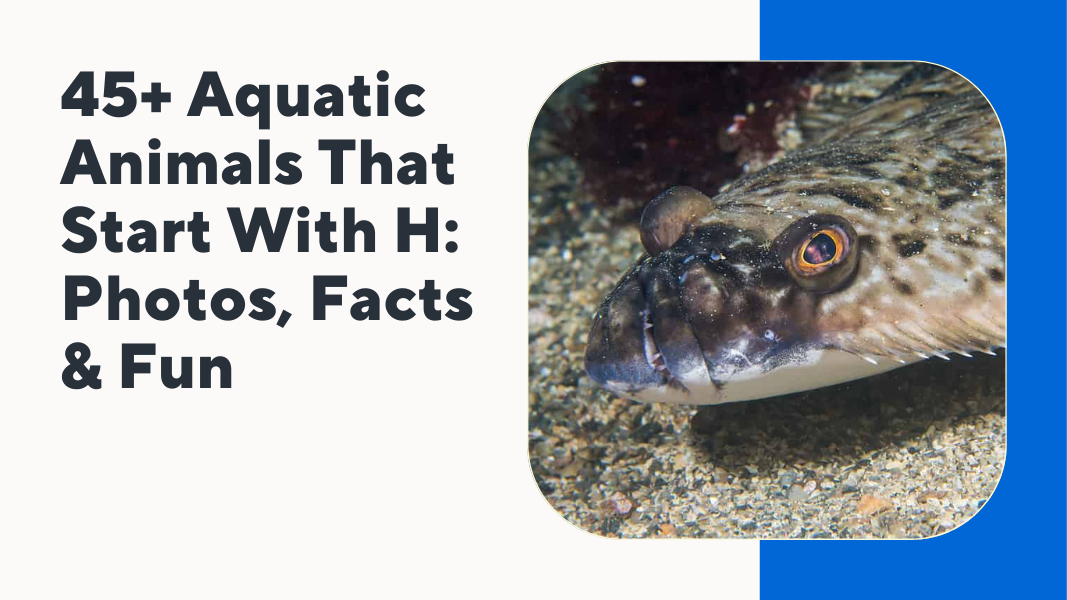
45+ Aquatic Animals That Start With H: Photos, Facts & Fun
Aquatic animals are a diverse and fascinating group, from microscopic plankton to massive marine mammals. In this comprehensive guide, we’ll explore aquatic animals that start with H—spanning oceans, lakes, rivers, and wetlands across the globe.
To help you better navigate this underwater alphabet, we’ve grouped these animals by type: mammals, fish, crustaceans, amphibians, reptiles, and more. Whether you’re a student, teacher, wildlife enthusiast, or trivia buff, you’ll find accurate facts, quick-reference data, and fun surprises in every entry. Ready to dive into the habitat, diet, and quirky traits of these “H” animals? Let’s get splashing!
Aquatic Animals That Start With H

Haddock (Melanogrammus aeglefinus)
The haddock is a cold-water marine fish found in the North Atlantic Ocean, particularly around Iceland, Norway, and the northeastern coast of North America. It has a slender silver-gray body with a distinctive black lateral line and a dark blotch above the pectoral fin often referred to as the “Devil’s thumbprint.” Haddocks feed on invertebrates such as worms, crustaceans, and mollusks. They are a key species in commercial fisheries and are commonly found in fish markets. These fish are generally bottom-dwellers and migrate seasonally in search of food and breeding grounds.
Quick Facts
| Attribute | Detail |
|---|---|
| Size | 38–69 cm (15–27 in) |
| Weight | 0.9–3.6 kg (2–8 lbs) |
| Lifespan | 10 years |
| Habitat | North Atlantic Ocean |
| Diet | Crustaceans, mollusks, worms |
| Social Structure | Schools |
| Conservation | Least Concern |
Fun Fact: Haddock is the key ingredient in traditional Scottish “Finnan haddie” smoked fish.
Hairy Frogfish (Antennarius striatus)
The hairy frogfish is a small, strange-looking ambush predator that thrives in tropical and subtropical waters around coral reefs. Covered in hair-like skin extensions that provide excellent camouflage, it can mimic seaweed and sponges. Instead of swimming, it “walks” on its modified pectoral fins along the seafloor. This carnivorous fish uses a worm-like lure on its head to attract prey and can gulp animals almost its own size in a split second.
Quick Facts
| Attribute | Detail |
|---|---|
| Size | 15–22 cm (6–9 in) |
| Weight | Up to 1.3 kg (2.8 lbs) |
| Lifespan | 3–5 years |
| Habitat | Coral reefs, Indo-Pacific |
| Diet | Small fish, crustaceans |
| Social Structure | Solitary |
| Conservation | Least Concern |
Fun Fact: The hairy frogfish can change its color and pattern to match its surroundings.
Harbor Porpoise (Phocoena phocoena)
The harbor porpoise is one of the smallest marine mammals and is commonly seen in cold coastal waters of the Northern Hemisphere. With a stout body, blunt snout, and triangular dorsal fin, it’s often mistaken for a dolphin. Unlike dolphins, harbor porpoises are shy and rarely perform acrobatics. They feed on schooling fish and squid, using echolocation to hunt in murky waters. Due to accidental entanglement in fishing gear, their population has been declining in some regions.
Quick Facts
| Attribute | Detail |
|---|---|
| Size | 1.4–1.9 m (4.6–6.2 ft) |
| Weight | 45–65 kg (99–143 lbs) |
| Lifespan | 8–12 years |
| Habitat | Coastal waters, North Atlantic |
| Diet | Fish, squid |
| Social Structure | Small pods |
| Conservation | Vulnerable |
Fun Fact: Harbor porpoises surface to breathe every 25 seconds when active.
Humphead Wrasse (Cheilinus undulatus)
This brightly colored reef fish is known for the large hump on its forehead and impressive size. Native to Indo-Pacific coral reefs, the humphead wrasse plays a crucial role in maintaining coral health by eating crown-of-thorns starfish. Males can grow significantly larger than females and change sex depending on population dynamics. Despite its ecological importance, this species is endangered due to overfishing and habitat destruction.
Quick Facts
| Attribute | Detail |
|---|---|
| Size | Up to 2.3 m (7.5 ft) |
| Weight | Up to 190 kg (419 lbs) |
| Lifespan | 30 years or more |
| Habitat | Coral reefs, Indo-Pacific |
| Diet | Mollusks, crustaceans, starfish |
| Social Structure | Solitary or small groups |
| Conservation | Endangered |
Fun Fact: Humphead wrasse are one of the few predators of toxic crown-of-thorns starfish.
Hammerhead Shark (Sphyrnidae family)
Hammerhead sharks are unmistakable due to their wide, flat, hammer-shaped heads. This unique head structure improves sensory perception and helps in locating prey hidden in the sand. They inhabit warm and temperate oceans worldwide and are often found in schools, especially during the day. Their diet consists of fish, squid, and stingrays. While some species are considered dangerous, most hammerheads avoid humans and pose little threat.
Quick Facts
| Attribute | Detail |
|---|---|
| Size | 1.5–6 m (5–20 ft) |
| Weight | 230–580 kg (500–1,280 lbs) |
| Lifespan | 20–30 years |
| Habitat | Tropical and temperate oceans |
| Diet | Fish, squid, rays |
| Social Structure | Schools (some species) |
| Conservation | Endangered (some species) |
Fun Fact: Hammerheads use their broad heads to pin stingrays to the ocean floor before eating them.
Horseshoe Crab (Limulus polyphemus)
Although not a true crab, the horseshoe crab is a marine arthropod related to spiders and scorpions. Found along the Atlantic coast of North America, it has a hard shell and a long, pointed tail. Horseshoe crabs play a key role in medical research, as their blue blood contains compounds essential for detecting bacterial contamination. They feed on worms and small clams on the ocean floor.
Quick Facts
| Attribute | Detail |
|---|---|
| Size | 30–60 cm (12–24 in) |
| Weight | Up to 4.5 kg (10 lbs) |
| Lifespan | 20–40 years |
| Habitat | Coastal flats, estuaries |
| Diet | Worms, mollusks |
| Social Structure | Solitary |
| Conservation | Near Threatened |
Fun Fact: Horseshoe crab blood is blue due to its copper-based oxygen-carrying molecule.
Hagfish (Myxini class)
Hagfish are jawless, eel-like creatures that inhabit deep-sea environments. Known for producing copious amounts of slime when threatened, these scavengers feed on dead or dying fish by burrowing into their bodies. They lack bones and have a cartilaginous skeleton, along with primitive eyes. Despite their grotesque habits, hagfish play an important role in marine cleanup and nutrient cycling.
Quick Facts
| Attribute | Detail |
|---|---|
| Size | 40–80 cm (16–31 in) |
| Weight | 0.6–1.2 kg (1.3–2.6 lbs) |
| Lifespan | 40 years |
| Habitat | Deep ocean floors |
| Diet | Carrion, dead fish |
| Social Structure | Solitary |
| Conservation | Least Concern |
Fun Fact: Hagfish can produce enough slime in seconds to clog a predator’s gills.
Hawaiian Monk Seal (Neomonachus schauinslandi)
Endemic to the Hawaiian Islands, the Hawaiian monk seal is one of the most endangered marine mammals in the world. These seals inhabit sandy beaches and coastal waters, often resting on remote atolls. They feed on reef-dwelling prey, including octopus, crustaceans, and fish. Solitary by nature, monk seals spend much of their time diving and foraging alone. Conservation efforts have increased due to population declines caused by habitat loss, human disturbance, and entanglement in marine debris.
Quick Facts
| Attribute | Detail |
|---|---|
| Size | 2.1–2.4 m (7–8 ft) |
| Weight | 180–270 kg (400–600 lbs) |
| Lifespan | 25–30 years |
| Habitat | Hawaiian coasts, atolls |
| Diet | Fish, octopus, crustaceans |
| Social Structure | Solitary |
| Conservation | Endangered |
Fun Fact: The Hawaiian monk seal is one of only two remaining monk seal species in the world.
Hoki (Macruronus novaezelandiae)
Also known as blue grenadier, the hoki is a deep-sea fish commonly found around New Zealand and southern Australia. With its elongated body and silvery-blue scales, it thrives at depths of 200–1,000 meters. Hoki is highly valued in commercial fisheries and often used in processed foods like fish fillets and fast-food sandwiches. Its diet consists of smaller fish, crustaceans, and squid. Though widely fished, sustainable management has helped maintain its populations.
Quick Facts
| Attribute | Detail |
|---|---|
| Size | 60–130 cm (24–51 in) |
| Weight | Up to 6 kg (13 lbs) |
| Lifespan | 20–25 years |
| Habitat | Deep waters near continental slopes |
| Diet | Fish, crustaceans, squid |
| Social Structure | Schools |
| Conservation | Least Concern |
Fun Fact: Hoki is the main fish used in McDonald’s Filet-O-Fish sandwiches.
Harlequin Tuskfish (Choerodon fasciatus)
This vibrant reef fish is a favorite among aquarium enthusiasts due to its bold blue and orange bands and striking tusk-like teeth. Native to coral reefs in the Western Pacific, the harlequin tuskfish uses its strong jaws to crack open hard-shelled prey such as crabs and snails. It’s territorial and prefers solitary living. Although not endangered, it’s vulnerable to habitat degradation and over-collection for the pet trade.
Quick Facts
| Attribute | Detail |
|---|---|
| Size | 20–30 cm (8–12 in) |
| Weight | Up to 0.9 kg (2 lbs) |
| Lifespan | 10–15 years |
| Habitat | Coral reefs, Western Pacific |
| Diet | Crustaceans, mollusks |
| Social Structure | Solitary |
| Conservation | Least Concern |
Fun Fact: Harlequin tuskfish have actual “fangs” that protrude from their mouths and help them grasp prey.
Humpback Whale (Megaptera novaeangliae)
The humpback whale is one of the most iconic baleen whales, renowned for its haunting songs and acrobatic breaches. Found in oceans worldwide, these massive mammals undertake long migrations between feeding and breeding grounds—sometimes over 8,000 km. They feed primarily on krill and small fish, using a cooperative method called bubble-net feeding. Once heavily hunted, their numbers have rebounded thanks to international protections.
Quick Facts
| Attribute | Detail |
|---|---|
| Size | 12–16 m (40–52 ft) |
| Weight | 25–30 tonnes (55,000–66,000 lbs) |
| Lifespan | 45–50 years |
| Habitat | All major oceans |
| Diet | Krill, small fish |
| Social Structure | Pods or solitary |
| Conservation | Least Concern |
Fun Fact: Each humpback whale has a unique tail pattern, like a fingerprint.
Hairy Hermit Crab (Aniculus maximus)
The hairy hermit crab is a large, vividly colored crustacean known for occupying discarded snail shells. Found in coral reef environments of the Indo-Pacific, this crab uses its strong claws to fend off predators and scavenge for algae, detritus, and small invertebrates. Its “hairy” appearance comes from the bristly setae covering its limbs. Hermit crabs must regularly find new shells as they grow, making suitable shells a limited and valuable resource.
Quick Facts
| Attribute | Detail |
|---|---|
| Size | 10–20 cm (4–8 in) |
| Weight | Up to 0.5 kg (1.1 lbs) |
| Lifespan | 10–15 years |
| Habitat | Coral reefs, Indo-Pacific |
| Diet | Detritus, algae, small animals |
| Social Structure | Solitary |
| Conservation | Least Concern |
Fun Fact: Hairy hermit crabs often share their shells with sea anemones for mutual protection.
Hickory Shad (Alosa mediocris)
Native to the U.S. Atlantic coast, the hickory shad is an anadromous fish, meaning it migrates from saltwater to freshwater rivers to spawn. This silvery fish is closely related to the American shad and is prized among anglers for its strength and fight. It feeds on plankton, small crustaceans, and fish larvae during its ocean phase. Hickory shad populations have fluctuated due to damming and habitat loss in spawning rivers.
Quick Facts
| Attribute | Detail |
|---|---|
| Size | 30–40 cm (12–16 in) |
| Weight | 1–2 kg (2.2–4.4 lbs) |
| Lifespan | 4–6 years |
| Habitat | Atlantic coastal rivers |
| Diet | Zooplankton, larvae, insects |
| Social Structure | Schools |
| Conservation | Least Concern |
Fun Fact: Hickory shad are known for leaping out of the water when hooked.
Hawaiian Cleaner Wrasse (Labroides phthirophagus)
This brightly colored reef fish plays an essential role in reef ecosystems by cleaning parasites off larger fish. Found only in Hawaiian waters, the Hawaiian cleaner wrasse has a purple and yellow body and sets up “cleaning stations” where fish come to be groomed. The wrasse feeds on skin parasites, dead tissue, and mucus. Its mutualistic relationship with other reef dwellers makes it vital for coral reef health.
Quick Facts
| Attribute | Detail |
|---|---|
| Size | 10–14 cm (4–5.5 in) |
| Weight | <0.1 kg (<0.2 lbs) |
| Lifespan | 4–5 years |
| Habitat | Coral reefs, Hawaii |
| Diet | Parasites, dead tissue |
| Social Structure | Pairs or harems |
| Conservation | Least Concern |
Fun Fact: Cleaner wrasses perform a “dance” to attract fish to their cleaning station.
Hooded Seal (Cystophora cristata)
The hooded seal is a large, cold-water pinniped known for the inflatable nasal sac that males use to attract mates and intimidate rivals. These seals inhabit the North Atlantic and Arctic oceans, often found on pack ice and deep ocean waters. They dive to great depths to forage on squid, fish, and crustaceans. Pups, called “bluebacks” due to their distinct pelage, are among the fastest-growing mammals, weaning in just four days. Due to climate change and ice loss, their populations are being closely monitored.
Quick Facts
| Attribute | Detail |
|---|---|
| Size | 2–2.7 m (6.5–9 ft) |
| Weight | 200–400 kg (440–880 lbs) |
| Lifespan | 25–35 years |
| Habitat | North Atlantic, Arctic Ocean |
| Diet | Fish, squid, crustaceans |
| Social Structure | Solitary or small groups |
| Conservation | Vulnerable |
Fun Fact: Males can inflate their nasal hood into a large red balloon to assert dominance.
Halfbanded Angelfish (Genicanthus semicinctus)
Native to the Western Pacific Ocean, the halfbanded angelfish is a visually striking species with vertical blue and white stripes. Found on deep coral reefs, it typically inhabits drop-offs and outer reef slopes. Males are more vibrantly colored than females, and like many angelfish, the species is protogynous, meaning females can turn into males. Their diet consists of zooplankton and small invertebrates.
Quick Facts
| Attribute | Detail |
|---|---|
| Size | 18–20 cm (7–8 in) |
| Weight | Up to 0.3 kg (0.7 lbs) |
| Lifespan | 10–15 years |
| Habitat | Coral reefs, Western Pacific |
| Diet | Zooplankton, invertebrates |
| Social Structure | Harems |
| Conservation | Least Concern |
Fun Fact: Only female halfbanded angelfish are initially born—dominant ones change to male.
Humpback Grouper (Cromileptes altivelis)
Also called the panther grouper, this fish is known for its unique appearance—white body with black polka dots and a humped back. Native to the Indo-Pacific region, it resides in lagoons and seaward reefs. The humpback grouper is a slow-growing ambush predator that feeds on crustaceans and small fish. Due to its high value in the aquarium and food trade, it is now considered vulnerable in the wild.
Quick Facts
| Attribute | Detail |
|---|---|
| Size | Up to 70 cm (28 in) |
| Weight | Up to 10 kg (22 lbs) |
| Lifespan | 25–30 years |
| Habitat | Coral reefs, Indo-Pacific |
| Diet | Fish, crustaceans |
| Social Structure | Solitary |
| Conservation | Vulnerable |
Fun Fact: Juvenile humpback groupers mimic poisonous flatworms to avoid predators.
Helmet Jellyfish (Periphylla periphylla)
The helmet jellyfish is a deep-sea species recognized for its reddish, bell-shaped body that resembles a medieval helmet. It thrives in cold, dark ocean depths and avoids light by performing vertical migrations at night. Unlike most jellyfish, it has no medusa stage and develops directly from an egg. It preys on small fish and zooplankton using its stinging tentacles.
Quick Facts
| Attribute | Detail |
|---|---|
| Size | 10–35 cm (4–14 in) |
| Weight | Up to 0.5 kg (1.1 lbs) |
| Lifespan | Unknown |
| Habitat | Deep-sea, global oceans |
| Diet | Zooplankton, small fish |
| Social Structure | Solitary |
| Conservation | Not Evaluated |
Fun Fact: Helmet jellyfish are bioluminescent, glowing in the dark ocean depths.
Hawksbill Sea Turtle (Eretmochelys imbricata)
The hawksbill sea turtle is a critically endangered marine reptile known for its narrow, pointed beak and beautifully patterned shell. It inhabits tropical coral reefs and seagrass beds across the Atlantic, Pacific, and Indian Oceans. Feeding primarily on sponges and soft corals, it plays a crucial role in maintaining reef health. Its ornate shell made it a target for illegal tortoiseshell trade, contributing to its sharp population decline.
Quick Facts
| Attribute | Detail |
|---|---|
| Size | 70–90 cm (28–35 in) |
| Weight | 45–70 kg (99–154 lbs) |
| Lifespan | 30–50 years |
| Habitat | Tropical coral reefs |
| Diet | Sponges, soft corals |
| Social Structure | Solitary |
| Conservation | Critically Endangered |
Fun Fact: Hawksbills can tolerate eating toxic sponges that other animals avoid.
Horn Shark (Heterodontus francisci)
Native to the coastal waters of the eastern Pacific Ocean, the horn shark is a small, slow-moving bottom-dweller. It gets its name from the blunt spines in front of its dorsal fins. Found near rocky reefs and kelp forests, it rests during the day and hunts at night. It feeds on hard-shelled prey like crabs, sea urchins, and mollusks. While not dangerous, its spines can injure predators or careless handlers.
Quick Facts
| Attribute | Detail |
|---|---|
| Size | 60–120 cm (24–47 in) |
| Weight | Up to 9 kg (20 lbs) |
| Lifespan | 25 years |
| Habitat | Rocky reefs, Pacific coast |
| Diet | Crustaceans, mollusks, urchins |
| Social Structure | Solitary |
| Conservation | Least Concern |
Fun Fact: Horn sharks use suction feeding to extract prey from rocky crevices.
Hagerman Horse (Extinct) (Equus simplicidens)
While not technically aquatic, the Hagerman horse fossil was discovered near an ancient lake bed in Idaho. This extinct species, closely related to zebras, lived during the Pliocene epoch and likely frequented riverbanks and wetlands for food and water. It stood about the same size as a modern donkey and is considered one of the oldest known horse species in North America.
Quick Facts
| Attribute | Detail |
|---|---|
| Size | 1.4 m (4.6 ft) at shoulder |
| Weight | 300–400 kg (660–880 lbs) |
| Lifespan | Unknown |
| Habitat | Wetlands, grasslands (prehistoric) |
| Diet | Grasses, aquatic plants |
| Social Structure | Herds |
| Conservation | Extinct |
Fun Fact: Fossils of over 200 individuals were found at the Hagerman Fossil Beds in Idaho.
Herring (Clupea harengus)
Herring are small, silvery fish that travel in massive schools across the North Atlantic and Pacific Oceans. They play a vital role in marine ecosystems as both predators and prey. Herring feed on plankton and are a major food source for whales, seabirds, and larger fish. These migratory fish are heavily fished for human consumption, often salted, pickled, or smoked. Despite intense harvesting, herring populations remain relatively stable in well-managed fisheries.
Quick Facts
| Attribute | Detail |
|---|---|
| Size | 20–38 cm (8–15 in) |
| Weight | 0.2–0.5 kg (0.4–1.1 lbs) |
| Lifespan | 15 years |
| Habitat | Coastal oceans, Atlantic, Pacific |
| Diet | Zooplankton, fish larvae |
| Social Structure | Large schools |
| Conservation | Least Concern |
Fun Fact: A single herring school can contain billions of fish moving in unison.
Halibut (Hippoglossus hippoglossus)
The Atlantic halibut is one of the largest flatfish species, living along cold northern seafloors. As ambush predators, halibut lie camouflaged on the ocean bottom and lunge upward to catch prey such as fish, squid, and crustaceans. Notably asymmetric, both eyes are on the right side of their body. These fish are prized in commercial fisheries for their firm white meat, but overfishing has made conservation crucial.
Quick Facts
| Attribute | Detail |
|---|---|
| Size | Up to 2.5 m (8.2 ft) |
| Weight | Up to 320 kg (705 lbs) |
| Lifespan | 40+ years |
| Habitat | North Atlantic seafloor |
| Diet | Fish, squid, crustaceans |
| Social Structure | Solitary |
| Conservation | Endangered |
Fun Fact: Halibut are born with eyes on both sides but one migrates as they mature.
Helmet Crab (Telmessus cheiragonus)
Also known as the helmet shore crab, this crustacean inhabits cold North Pacific coastal waters, particularly around Japan and Russia. It gets its name from the domed, helmet-like shape of its carapace. Helmet crabs are scavengers and omnivores, feeding on algae, small invertebrates, and organic debris. They play a role in breaking down detritus in intertidal ecosystems.
Quick Facts
| Attribute | Detail |
|---|---|
| Size | 5–8 cm (2–3.1 in) |
| Weight | Up to 100 g (3.5 oz) |
| Lifespan | 4–5 years |
| Habitat | Rocky shores, Pacific coasts |
| Diet | Algae, detritus, small animals |
| Social Structure | Solitary |
| Conservation | Not Evaluated |
Fun Fact: Helmet crabs molt their shells to grow and are vulnerable during the soft-shell stage.
Hammerjaw (Omosudis lowii)
The hammerjaw is a rarely seen deep-sea fish with a fearsome appearance—featuring long sharp teeth and a large mouth adapted for snatching prey in darkness. It lives in the mesopelagic and bathypelagic zones of tropical and subtropical oceans. Hammerjaws are fast predators, feeding on small fish and squid. Despite their intimidating look, they pose no threat to humans and are elusive in nature.
Quick Facts
| Attribute | Detail |
|---|---|
| Size | 20–30 cm (8–12 in) |
| Weight | ~300 g (0.7 lbs) |
| Lifespan | Unknown |
| Habitat | Deep ocean, worldwide |
| Diet | Fish, squid |
| Social Structure | Solitary |
| Conservation | Not Evaluated |
Fun Fact: The hammerjaw’s muscle structure is adapted for sudden high-speed strikes in the dark.
Hairy Squat Lobster (Lauriea siagiani)
Despite its name, this small crustacean is neither a lobster nor particularly hairy—it gets its name from its fuzzy pinkish appearance. Found in the crevices of giant barrel sponges in the Indo-Pacific, the hairy squat lobster is a cryptic species known for its vivid coloration. It grazes on detritus and plankton in its sponge home, rarely straying far from shelter. Though rarely seen, it’s a popular subject in macro photography.
Quick Facts
| Attribute | Detail |
|---|---|
| Size | 1–2.5 cm (0.4–1 in) |
| Weight | <10 g (0.35 oz) |
| Lifespan | 2–4 years |
| Habitat | Barrel sponges, Indo-Pacific |
| Diet | Plankton, detritus |
| Social Structure | Solitary |
| Conservation | Not Evaluated |
Fun Fact: Hairy squat lobsters have bright purple claws and live exclusively in sponge crevices.
Hooded Nudibranch (Melibe leonina)
The hooded nudibranch, also called the lion’s mane nudibranch, is a translucent sea slug found in the Pacific waters from Alaska to California. It uses a large, hood-like oral veil to trap plankton and small crustaceans. With no shell and jelly-like texture, it moves gracefully through the water using undulating motions. Despite their delicate appearance, they are hardy and capable of regenerating lost body parts.
Quick Facts
| Attribute | Detail |
|---|---|
| Size | 4–10 cm (1.6–4 in) |
| Weight | ~20 g (0.7 oz) |
| Lifespan | 1 year |
| Habitat | Kelp forests, Pacific Ocean |
| Diet | Plankton, crustaceans |
| Social Structure | Solitary |
| Conservation | Least Concern |
Fun Fact: Hooded nudibranchs smell like watermelon when handled.
Humpback Glassfish (Parambassis pulcinella)
Native to freshwater rivers in Myanmar, the humpback glassfish is named for its high-arched back and semi-transparent body. This unusual fish is often found in slow-moving, shaded streams and is popular in the aquarium trade due to its unique profile and shimmering body. It feeds on small invertebrates and insects. Though not well studied, it’s presumed to be a peaceful schooling species in the wild.
Quick Facts
| Attribute | Detail |
|---|---|
| Size | 6–8 cm (2.4–3.1 in) |
| Weight | ~20 g (0.7 oz) |
| Lifespan | 3–5 years |
| Habitat | Freshwater rivers, Myanmar |
| Diet | Insects, zooplankton |
| Social Structure | Small schools |
| Conservation | Not Evaluated |
Fun Fact: Their semi-transparent bodies make them appear to glow in aquarium lighting.
Horseface Loach (Acantopsis choirorhynchos)
This freshwater bottom-dweller is named for its long, horse-like snout, which it uses to dig through substrate in search of food. Native to Southeast Asia, the horseface loach prefers sandy riverbeds and is mostly active at night. It feeds on worms, insect larvae, and small crustaceans. Though peaceful, it’s shy and often hides under sand or gravel during the day.
Quick Facts
| Attribute | Detail |
|---|---|
| Size | 15–20 cm (6–8 in) |
| Weight | ~80 g (2.8 oz) |
| Lifespan | 8–10 years |
| Habitat | Freshwater rivers, SE Asia |
| Diet | Worms, insects, crustaceans |
| Social Structure | Solitary or loose groups |
| Conservation | Least Concern |
Fun Fact: Horseface loaches can burrow completely under sand to hide or sleep.
Hawaiian Bobtail Squid (Euprymna scolopes)
This tiny cephalopod is famous for its symbiotic relationship with bioluminescent bacteria. Found in shallow coastal waters around Hawaii, the Hawaiian bobtail squid hides during the day and emerges at night to hunt. Its bacterial light helps it avoid casting a shadow and deters predators. It feeds on small shrimp and worms and uses jet propulsion for fast escapes.
Quick Facts
| Attribute | Detail |
|---|---|
| Size | 3–4 cm (1.2–1.6 in) |
| Weight | ~2 g (0.07 oz) |
| Lifespan | 3–10 months |
| Habitat | Coastal shallows, Hawaii |
| Diet | Shrimp, worms |
| Social Structure | Solitary |
| Conservation | Not Evaluated |
Fun Fact: Hawaiian bobtail squid glow thanks to bacteria they house in a special light organ.
Humphead Glass Perchlet (Chanda nama)
A small, translucent freshwater fish found in South and Southeast Asia, this species often inhabits ponds, lakes, and slow-moving rivers. It is sometimes used in mosquito control due to its appetite for larvae. Though shy, it’s adaptable and tolerates brackish conditions. In the wild, it forms small schools and feeds on zooplankton and tiny aquatic insects.
Quick Facts
| Attribute | Detail |
|---|---|
| Size | 4–5 cm (1.6–2 in) |
| Weight | ~5 g (0.17 oz) |
| Lifespan | 2–3 years |
| Habitat | Fresh/brackish waters, Asia |
| Diet | Zooplankton, insect larvae |
| Social Structure | Schools |
| Conservation | Least Concern |
Fun Fact: Their bodies can become nearly invisible in clear water due to their transparency.
Himalayan Stream Loach (Schistura beavani)
This bottom-dwelling fish thrives in fast-flowing, oxygen-rich mountain streams of the Himalayas. It has a slender, cylindrical body with dark vertical stripes and uses its barbels to feel the substrate. It clings to rocks using a flattened belly, making it well adapted to turbulent waters. It feeds on algae, insect larvae, and detritus.
Quick Facts
| Attribute | Detail |
|---|---|
| Size | 6–8 cm (2.4–3.1 in) |
| Weight | ~15 g (0.5 oz) |
| Lifespan | 4–6 years |
| Habitat | Mountain streams, Himalayas |
| Diet | Algae, insects, detritus |
| Social Structure | Small groups |
| Conservation | Least Concern |
Fun Fact: Himalayan stream loaches can breathe through their skin in oxygen-rich waters.
Hasselt’s Goby (Glossogobius giuris)
Widespread across Asia and Africa, this adaptable fish lives in freshwater, brackish, and even marine environments. Hasselt’s goby is a benthic species, spending most of its time near the substrate, often under rocks or vegetation. It’s an opportunistic feeder, consuming insects, small crustaceans, and fish fry. It’s important both ecologically and as a subsistence food fish in some regions.
Quick Facts
| Attribute | Detail |
|---|---|
| Size | 10–15 cm (4–6 in) |
| Weight | ~60 g (2.1 oz) |
| Lifespan | 3–5 years |
| Habitat | Rivers, estuaries, coasts |
| Diet | Insects, fry, crustaceans |
| Social Structure | Solitary |
| Conservation | Least Concern |
Fun Fact: Hasselt’s goby can tolerate a wide range of salinity, allowing it to live in both rivers and coasts.
Haller’s Razorclam (Ensis directus)
Commonly found along the Atlantic coasts of North America and Europe, Haller’s razorclam is a fast-burrowing bivalve with an elongated, blade-like shell. It lives in sandy or muddy substrates and can quickly retreat deep into the sediment to escape predators. It feeds by filter-feeding microscopic algae and plankton from the water column. Razorclams are harvested for food in some coastal regions.
Quick Facts
| Attribute | Detail |
|---|---|
| Size | 10–20 cm (4–8 in) |
| Weight | ~100 g (3.5 oz) |
| Lifespan | 10–15 years |
| Habitat | Sandy coastal seabeds |
| Diet | Plankton, microalgae |
| Social Structure | Colonies |
| Conservation | Least Concern |
Fun Fact: Razorclams can dig downward at speeds of up to 1 cm per second using a powerful foot muscle.
Harlequin Shrimp (Hymenocera picta)
The harlequin shrimp is one of the ocean’s most visually stunning crustaceans, known for its blue and pink polka-dotted pattern. Found in coral reefs of the Indo-Pacific, it hunts starfish—its exclusive prey. The shrimp works in mated pairs to flip starfish and consume them slowly over several days. Despite its beauty, it is rare in the wild and highly sensitive to changes in reef health.
Quick Facts
| Attribute | Detail |
|---|---|
| Size | 2–5 cm (0.8–2 in) |
| Weight | ~20 g (0.7 oz) |
| Lifespan | 3–5 years |
| Habitat | Coral reefs, Indo-Pacific |
| Diet | Starfish |
| Social Structure | Monogamous pairs |
| Conservation | Not Evaluated |
Fun Fact: Harlequin shrimp “dance” as they approach prey—possibly to confuse or hypnotize.
Hairy Blenny (Labrisomus nuchipinnis)
Found in the western Atlantic and Caribbean, the hairy blenny is a small, cryptic fish that hides in crevices of coral reefs and rocky shores. Named for the cirri (whisker-like structures) on its head, this fish is territorial and aggressively defends its hiding spot. It feeds on small crustaceans, worms, and mollusks. Its mottled color helps it blend into algae-covered rocks.
Quick Facts
| Attribute | Detail |
|---|---|
| Size | 10–15 cm (4–6 in) |
| Weight | ~50 g (1.8 oz) |
| Lifespan | 4–6 years |
| Habitat | Rocky reefs, western Atlantic |
| Diet | Crustaceans, mollusks, worms |
| Social Structure | Solitary |
| Conservation | Least Concern |
Fun Fact: Hairy blennies have “eyebrow” tufts that give them a comical expression.
Humpback Cardinalfish (Apogon compressus)
Native to reef environments of the Indo-Pacific, this cardinalfish is named for the slight hump on its back and its compressed body shape. It is nocturnal, hiding in rock crevices or coral during the day and feeding at night. It eats zooplankton, larvae, and small crustaceans. Like many cardinalfish, the male incubates eggs in his mouth until they hatch—a process known as mouthbrooding.
Quick Facts
| Attribute | Detail |
|---|---|
| Size | 6–8 cm (2.4–3.1 in) |
| Weight | ~15 g (0.5 oz) |
| Lifespan | 2–4 years |
| Habitat | Coral reefs, Indo-Pacific |
| Diet | Zooplankton, larvae |
| Social Structure | Small groups or pairs |
| Conservation | Least Concern |
Fun Fact: Male humpback cardinalfish carry fertilized eggs in their mouths to protect them from predators.
Hydra (Hydra vulgaris)
The hydra is a tiny, freshwater invertebrate known for its regenerative abilities. Found in ponds, streams, and quiet freshwater habitats worldwide, it attaches to surfaces with a foot-like structure and uses tentacles to catch small prey like daphnia and other microcrustaceans. Though not technically a “classic animal” in appearance, the hydra has a simple nervous system and reproduces both sexually and asexually.
Quick Facts
| Attribute | Detail |
|---|---|
| Size | 1–20 mm (0.04–0.8 in) |
| Weight | Negligible |
| Lifespan | Theoretically immortal (asexual) |
| Habitat | Freshwater ponds, slow rivers |
| Diet | Microcrustaceans, larvae |
| Social Structure | Solitary |
| Conservation | Not Evaluated |
Fun Fact: Hydra can regenerate from a tiny fragment—making them a key species in regeneration studies.
Haeckel’s Jellyfish (Desmonema annasethe)
Named after biologist Ernst Haeckel, this rare and beautiful jellyfish is known for its long, thread-like tentacles that can extend several meters. It inhabits cold Antarctic waters and floats with its bell near the surface while trailing tentacles below to capture prey. Like most jellyfish, it is composed largely of water and moves via pulsating contractions of its bell. Its sting is potent but not lethal to humans.
Quick Facts
| Attribute | Detail |
|---|---|
| Size | Bell: up to 50 cm (20 in) |
| Weight | Up to 2.5 kg (5.5 lbs) |
| Lifespan | Unknown |
| Habitat | Antarctic Ocean |
| Diet | Zooplankton, small fish |
| Social Structure | Solitary |
| Conservation | Not Evaluated |
Fun Fact: Its mesmerizing appearance inspired several of Haeckel’s famous biological illustrations.
Hydrocynus (Tiger Fish) (Hydrocynus vittatus)
Often referred to as the African tiger fish, this fierce freshwater predator is known for its sharp teeth and aggressive hunting behavior. Found in Africa’s Congo River Basin and Lake Tanganyika, it uses its streamlined body and muscular build to chase down prey. It feeds primarily on other fish, often leaping out of the water during attacks. Revered by anglers for its fight, it’s one of the continent’s most iconic river predators.
Quick Facts
| Attribute | Detail |
|---|---|
| Size | 70–105 cm (28–41 in) |
| Weight | Up to 28 kg (62 lbs) |
| Lifespan | 10–14 years |
| Habitat | African rivers and lakes |
| Diet | Fish, invertebrates |
| Social Structure | Solitary or small groups |
| Conservation | Least Concern |
Fun Fact: Tiger fish can growl using their swim bladders—an unusual trait for a bony fish.
Halfmoon Fish (Medialuna californiensis)
This sleek, silvery fish gets its name from the curved shape of its tail fin. Found along the Pacific coast of California and Baja, the halfmoon fish is a reef-dweller, often seen swimming in small schools near kelp forests and rocky bottoms. It’s an omnivore, feeding on algae, plankton, and small invertebrates. It’s also popular in sport fishing due to its agility.
Quick Facts
| Attribute | Detail |
|---|---|
| Size | 25–40 cm (10–16 in) |
| Weight | ~1.5 kg (3.3 lbs) |
| Lifespan | 8–10 years |
| Habitat | Pacific coast, kelp reefs |
| Diet | Algae, plankton, invertebrates |
| Social Structure | Schools |
| Conservation | Least Concern |
Fun Fact: Halfmoon fish often associate with larger species like kelp bass for protection.
Houndshark (Triakidae family)
Houndsharks include several species that inhabit coastal waters worldwide, including the smooth-hound and leopard shark. They are small to medium-sized sharks known for their docile nature and preference for sandy or muddy seafloors. Houndsharks feed on crabs, shrimp, and small fish. They are viviparous, giving birth to live young after internal fertilization. While not dangerous to humans, they are frequently caught in fisheries.
Quick Facts
| Attribute | Detail |
|---|---|
| Size | 1–1.5 m (3.3–5 ft) |
| Weight | 10–25 kg (22–55 lbs) |
| Lifespan | 20–25 years |
| Habitat | Coastal oceans worldwide |
| Diet | Crustaceans, fish |
| Social Structure | Groups |
| Conservation | Varies by species |
Fun Fact: Some houndsharks can detect weak electric fields to find prey buried in sand.
Hypselobarbus (Hump-backed Mahseer) (Hypselobarbus mussullah)
Endemic to India, this large freshwater fish is known for its humped back and powerful swimming ability. Found in rivers and large streams, the hump-backed mahseer is a bottom feeder that consumes aquatic vegetation, crustaceans, and detritus. It is highly valued by anglers and plays a key role in local river ecosystems, though pollution and damming have affected its habitat.
Quick Facts
| Attribute | Detail |
|---|---|
| Size | Up to 90 cm (35 in) |
| Weight | Up to 25 kg (55 lbs) |
| Lifespan | 15–20 years |
| Habitat | Rivers in India |
| Diet | Algae, detritus, invertebrates |
| Social Structure | Small groups |
| Conservation | Near Threatened |
Fun Fact: Hypselobarbus are known to migrate upstream during the monsoon to spawn.
Read: Animals That Start With H
Read: Animes That Start With K
Read: Animals That Start With C
Read: Animals That Start With Q
Read: Animals That Start With U
FAQs About Aquatic Animals That Start With H
How many aquatic animals start with the letter H?
There are over 45 unique aquatic animals that start with H, including mammals, fish, invertebrates, reptiles, and even extinct species.
Which H animal is the most endangered?
The Hawksbill sea turtle and Hawaiian monk seal are both critically endangered due to habitat loss, poaching, and climate change.
Are all animals on this list saltwater species?
No—this list includes both saltwater and freshwater species, such as the horseface loach and hydra, which thrive in rivers and ponds.
Do any of these animals have interesting behaviors?
Yes! The harlequin shrimp hunts starfish exclusively, and humpback whales perform cooperative bubble-net feeding to catch fish.
Can I keep any of these H animals in an aquarium?
Some, like the halfbanded angelfish or humpback glassfish, are kept in home aquariums, but others—like sharks or jellyfish—are better suited for public exhibits.
Conclusion: Exploring the World of H-Named Aquatic Creatures
From the dazzling harlequin shrimp to the mighty humpback whale, the world of aquatic animals that start with H is surprisingly vast and filled with wonder. These creatures showcase a wide range of habitats, diets, and behaviors—from coral reefs to deep-sea trenches, and from solitary hunters to social schools.
Whether you’re fascinated by biology or simply love the ocean, diving into these H animals is a fantastic way to learn about life beneath the surface. Keep exploring—there’s always more in the deep blue sea.


