45+ African Animals That Start With B: Photos, Facts & Fun
Africa is home to some of the most diverse and fascinating wildlife on Earth, ranging from massive land mammals to colorful birds, stealthy reptiles, and unique insects. In this guide to african animals that start with b, you’ll find a carefully researched and complete list of species found across the continent. To make exploration easier, these animals are naturally grouped by type, including mammals, birds, reptiles, amphibians, fish, and invertebrates.
Each animal profile includes key details such as habitat, physical traits, diet, behavior, and conservation status, along with a memorable fun fact. Whether you’re a student, wildlife enthusiast, or nature writer, this article offers an educational and engaging look at Africa’s biodiversity through one letter of the alphabet.
African Animals That Start With B
Baboon (Papio spp.)
Baboons are large, ground-dwelling primates found across savannas, woodlands, and rocky areas of Africa. They have long snouts, sharp canine teeth, and strong social bonds within troops. Adults can grow quite large and are highly adaptable in diet. Baboons eat fruits, seeds, insects, and small animals. They live in complex social hierarchies dominated by strong males.
Fun Fact: Baboons use more than 10 different vocalizations to communicate.
Quick Facts Table
| Attribute | Detail |
|---|---|
| Size | 50–86 cm / 20–34 in |
| Weight | 14–45 kg / 30–99 lb |
| Lifespan | 20–30 years |
| Habitat | Savannas, woodlands |
| Diet | Omnivore |
| Social Structure | Troop |
| Conservation | Least Concern |
Fun Fact: Some baboons can recognize written words through training.
Bat-Eared Fox (Otocyon megalotis)
The bat-eared fox is a small African fox known for its oversized ears. These ears help it regulate body temperature and detect insects underground. It mainly inhabits grasslands and semi-arid regions. Its diet consists largely of termites and other insects. Unlike most foxes, it has reduced teeth for grinding insects.
Fun Fact: A single fox can eat over one million termites per year.
Quick Facts Table
| Attribute | Detail |
|---|---|
| Size | 46–66 cm / 18–26 in |
| Weight | 3–5 kg / 6.6–11 lb |
| Lifespan | 10–13 years |
| Habitat | Grasslands |
| Diet | Insectivore |
| Social Structure | Small family groups |
| Conservation | Least Concern |
Fun Fact: Its ears can rotate independently.
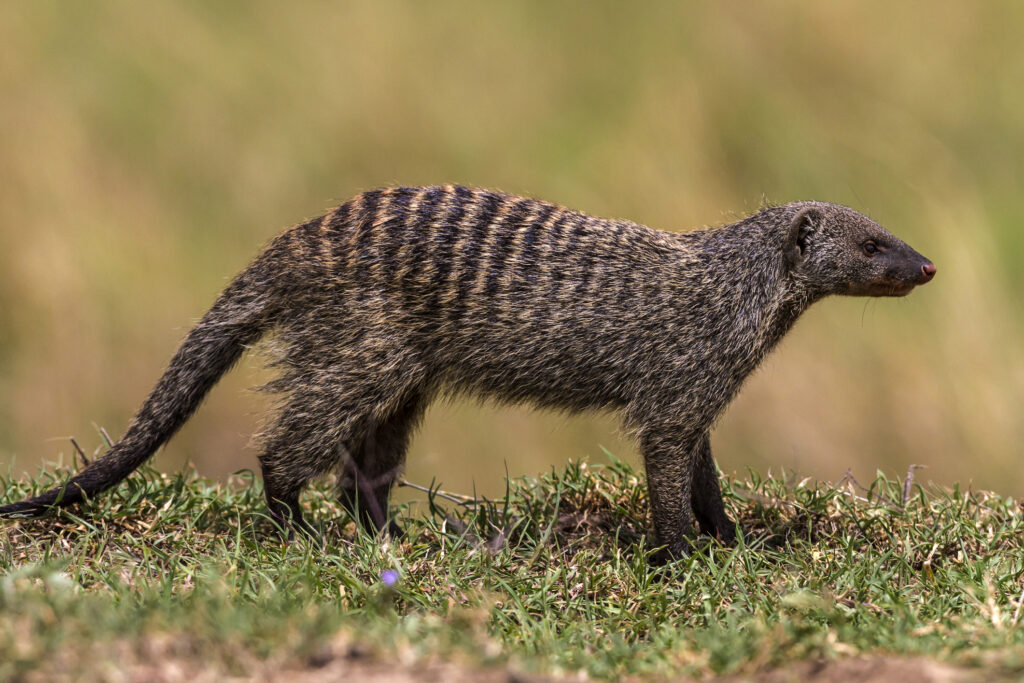
Banded Mongoose (Mungos mungo)
Banded mongooses are small mammals living in large cooperative groups. They have distinctive dark bands across their backs. Found in savannas and forests, they forage together for insects and small animals. Group members take turns babysitting young. They are fearless when facing predators like snakes.
Fun Fact: Groups vote by sneezing before moving to a new location.
Quick Facts Table
| Attribute | Detail |
|---|---|
| Size | 30–45 cm / 12–18 in |
| Weight | 1.5–2.5 kg / 3–5.5 lb |
| Lifespan | 10 years |
| Habitat | Savannas, forests |
| Diet | Omnivore |
| Social Structure | Large groups |
| Conservation | Least Concern |
Fun Fact: Sneezing helps them reach group decisions.
Bateleur Eagle (Terathopius ecaudatus)
The bateleur eagle is a striking bird of prey with bright red facial skin. It has short tail feathers and long wings for soaring. This eagle hunts reptiles, birds, and carrion. It is often seen gliding effortlessly over open land. Populations are declining due to habitat loss.
Fun Fact: Its name means “tight-rope walker” in French.
Quick Facts Table
| Attribute | Detail |
|---|---|
| Size | 55–70 cm / 22–28 in |
| Weight | 2–2.6 kg / 4.4–5.7 lb |
| Lifespan | 25 years |
| Habitat | Savannas |
| Diet | Carnivore |
| Social Structure | Solitary |
| Conservation | Near Threatened |
Fun Fact: Bateleurs spend most of their day in flight.
Black Rhinoceros (Diceros bicornis)
Black rhinos are large, thick-skinned herbivores native to eastern and southern Africa. They are known for their hooked upper lip used to grasp vegetation. Despite their size, they can run surprisingly fast. Poaching has severely reduced their numbers. Conservation efforts are slowly helping populations recover.
Fun Fact: Each rhino’s horn is made of keratin, like human nails.
Quick Facts Table
| Attribute | Detail |
|---|---|
| Size | 3–3.8 m / 10–12.5 ft |
| Weight | 800–1,400 kg / 1,760–3,090 lb |
| Lifespan | 35–50 years |
| Habitat | Savannas, deserts |
| Diet | Herbivore |
| Social Structure | Mostly solitary |
| Conservation | Critically Endangered |
Fun Fact: Black rhinos can reach speeds of 55 km/h.
Blue Wildebeest (Connochaetes taurinus)
The blue wildebeest is famous for its role in Africa’s great migrations. It has a muscular build and curved horns. These animals live in large herds across grasslands. They feed mainly on grasses and migrate seasonally for water. Predators rely heavily on them for food.
Fun Fact: Over one million wildebeest migrate annually in East Africa.
Quick Facts Table
| Attribute | Detail |
|---|---|
| Size | 170–240 cm / 67–94 in |
| Weight | 180–250 kg / 400–550 lb |
| Lifespan | 20 years |
| Habitat | Grasslands |
| Diet | Herbivore |
| Social Structure | Large herds |
| Conservation | Least Concern |
Fun Fact: Their migration is visible from space.
Brown Hyena (Parahyaena brunnea)
Brown hyenas are scavengers found mainly in southern Africa. They have shaggy fur and strong jaws. Unlike spotted hyenas, they live in small family clans. They feed on carrion, fruits, and insects. They are shy and mostly nocturnal.
Fun Fact: Brown hyenas can carry bones long distances.
Quick Facts Table
| Attribute | Detail |
|---|---|
| Size | 130–160 cm / 51–63 in |
| Weight | 40–50 kg / 88–110 lb |
| Lifespan | 12–15 years |
| Habitat | Deserts, savannas |
| Diet | Scavenger |
| Social Structure | Clan |
| Conservation | Near Threatened |
Fun Fact: They rarely hunt live prey.
Bush Elephant (Loxodonta africana)
African bush elephants are the largest land animals on Earth. They inhabit savannas and forests. Their trunks are used for breathing, feeding, and communication. They consume massive amounts of vegetation daily. Elephants live in matriarch-led herds.
Fun Fact: An elephant’s trunk has over 40,000 muscles.
Quick Facts Table
| Attribute | Detail |
|---|---|
| Size | 6–7.5 m / 20–25 ft |
| Weight | 4,000–6,000 kg / 8,800–13,200 lb |
| Lifespan | 60–70 years |
| Habitat | Savannas |
| Diet | Herbivore |
| Social Structure | Herd |
| Conservation | Endangered |
Fun Fact: Elephants can recognize themselves in mirrors.
Bushbuck (Tragelaphus scriptus)
Bushbucks are shy antelopes with striped coats. They prefer dense vegetation near water. Mostly solitary, they feed on leaves and grasses. Males have spiral horns. They are excellent jumpers.
Fun Fact: Bushbucks can leap over 2 meters high.
Quick Facts Table
| Attribute | Detail |
|---|---|
| Size | 90–120 cm / 35–47 in |
| Weight | 30–80 kg / 66–176 lb |
| Lifespan | 12 years |
| Habitat | Forests, wetlands |
| Diet | Herbivore |
| Social Structure | Solitary |
| Conservation | Least Concern |
Fun Fact: Their stripes help with camouflage.
Butterfly Fish (Chaetodontidae)
Butterfly fish are colorful reef fish found in the Red Sea and Indian Ocean. They have flat bodies and striking patterns. These fish feed on coral polyps and small invertebrates. Many species form monogamous pairs. Coral reef loss threatens some populations.
Fun Fact: Some species mate for life.
Quick Facts Table
| Attribute | Detail |
|---|---|
| Size | 12–22 cm / 5–9 in |
| Weight | Up to 500 g / 1.1 lb |
| Lifespan | 5–10 years |
| Habitat | Coral reefs |
| Diet | Omnivore |
| Social Structure | Pairs |
| Conservation | Least Concern |
Fun Fact: Their colors confuse predators.
Bushbaby (Galago spp.)
Bushbabies are small nocturnal primates found in forests and woodlands across Africa. They have very large eyes adapted for night vision and powerful hind legs for jumping. Their diet includes insects, fruit, and tree gum. Bushbabies are agile climbers and can leap several meters between branches. They communicate using loud calls at night.
Fun Fact: Bushbabies can jump over 2 meters in a single leap.
Quick Facts Table
| Attribute | Detail |
|---|---|
| Size | 12–30 cm / 5–12 in |
| Weight | 95–300 g / 3–10 oz |
| Lifespan | 10–14 years |
| Habitat | Forests, woodlands |
| Diet | Omnivore |
| Social Structure | Solitary |
| Conservation | Least Concern |
Fun Fact: Their cries sound like a human baby.
Boomslang (Dispholidus typus)
The boomslang is a highly venomous tree snake found in sub-Saharan Africa. It has large eyes and excellent vision for hunting birds and reptiles. Unlike many snakes, its venom is slow-acting but extremely potent. Boomslangs are shy and avoid humans. Males are often bright green, while females are brown.
Fun Fact: Boomslangs have rear-facing fangs.
Quick Facts Table
| Attribute | Detail |
|---|---|
| Size | 1–1.6 m / 3.3–5.2 ft |
| Weight | Up to 500 g / 1.1 lb |
| Lifespan | 8–10 years |
| Habitat | Woodlands, forests |
| Diet | Carnivore |
| Social Structure | Solitary |
| Conservation | Least Concern |
Fun Fact: Their venom affects blood clotting.
Brown Snake Eagle (Circaetus cinereus)
This large raptor specializes in hunting snakes across African savannas. It has powerful talons and keen eyesight. Brown snake eagles often soar for long periods searching for prey. They are solitary and territorial birds. Habitat loss poses some risk to their populations.
Fun Fact: They can swallow snakes whole.
Quick Facts Table
| Attribute | Detail |
|---|---|
| Size | 62–70 cm / 24–28 in |
| Weight | 1.5–2.5 kg / 3.3–5.5 lb |
| Lifespan | 20+ years |
| Habitat | Savannas |
| Diet | Carnivore |
| Social Structure | Solitary |
| Conservation | Least Concern |
Fun Fact: Their legs are protected by thick scales.
Buffalo (Syncerus caffer)
African buffalo are massive herd animals found in grasslands and wetlands. They are known for their unpredictable temperament. Buffalo graze on grasses and stay close to water sources. Herds provide protection against predators like lions. They have strong social bonds.
Fun Fact: Buffalo herds will rescue members from predators.
Quick Facts Table
| Attribute | Detail |
|---|---|
| Size | 2–3.4 m / 6.5–11 ft |
| Weight | 500–900 kg / 1,100–2,000 lb |
| Lifespan | 20–25 years |
| Habitat | Grasslands, wetlands |
| Diet | Herbivore |
| Social Structure | Herd |
| Conservation | Least Concern |
Fun Fact: Buffalo never forget threats.
Black Mamba (Dendroaspis polylepis)
The black mamba is one of Africa’s most feared snakes. It is long, fast, and highly venomous. Despite its name, it is usually brown or gray. Black mambas prefer savannas and rocky hills. They avoid confrontation unless threatened.
Fun Fact: It can move at speeds up to 20 km/h.
Quick Facts Table
| Attribute | Detail |
|---|---|
| Size | 2–4.5 m / 6.5–14.8 ft |
| Weight | 1.6 kg / 3.5 lb |
| Lifespan | 11 years |
| Habitat | Savannas, rocky areas |
| Diet | Carnivore |
| Social Structure | Solitary |
| Conservation | Least Concern |
Fun Fact: Its mouth interior is jet black.
Blue Crane (Anthropoides paradiseus)
Blue cranes are tall, elegant birds native to southern Africa. They inhabit grasslands and open plains. Their long legs help them walk through tall vegetation. They feed on insects, seeds, and small animals. Blue cranes are South Africa’s national bird.
Fun Fact: They perform graceful courtship dances.
Quick Facts Table
| Attribute | Detail |
|---|---|
| Size | 100–120 cm / 39–47 in |
| Weight | 4–6 kg / 8.8–13 lb |
| Lifespan | 25 years |
| Habitat | Grasslands |
| Diet | Omnivore |
| Social Structure | Pairs |
| Conservation | Vulnerable |
Fun Fact: Their wing feathers trail along the ground.
Banded Snake Eagle (Circaetus cinerascens)
This medium-sized eagle hunts reptiles in wooded savannas. It has strong legs and excellent eyesight. Banded snake eagles perch quietly before striking prey. They are rarely seen due to their secretive nature.
Fun Fact: They specialize almost entirely on snakes.
Quick Facts Table
| Attribute | Detail |
|---|---|
| Size | 55–60 cm / 22–24 in |
| Weight | 1.2–1.8 kg / 2.6–4 lb |
| Lifespan | 18–20 years |
| Habitat | Wooded savannas |
| Diet | Carnivore |
| Social Structure | Solitary |
| Conservation | Least Concern |
Fun Fact: Their talons can crush reptile skulls.
Brown-Throated Sand Martin (Riparia paludicola)
This small migratory bird lives near rivers and lakes. It feeds on flying insects caught mid-air. Brown-throated sand martins nest in burrows dug into riverbanks. They migrate seasonally across Africa.
Fun Fact: They can fly continuously for hours.
Quick Facts Table
| Attribute | Detail |
|---|---|
| Size | 12–14 cm / 5–5.5 in |
| Weight | 12–15 g / 0.4–0.5 oz |
| Lifespan | 6–8 years |
| Habitat | Rivers, wetlands |
| Diet | Insectivore |
| Social Structure | Colonies |
| Conservation | Least Concern |
Fun Fact: They nest underground.
Bichir (Polypterus spp.)
Bichirs are ancient fish species found in African freshwater systems. They have primitive lungs allowing them to breathe air. Their elongated bodies resemble eels. Bichirs are nocturnal predators feeding on fish and invertebrates.
Fun Fact: They can survive out of water for hours.
Quick Facts Table
| Attribute | Detail |
|---|---|
| Size | 30–75 cm / 12–30 in |
| Weight | Up to 1.5 kg / 3.3 lb |
| Lifespan | 15–20 years |
| Habitat | Rivers, swamps |
| Diet | Carnivore |
| Social Structure | Solitary |
| Conservation | Least Concern |
Fun Fact: They are considered living fossils.
Bronze Mannikin (Spermestes cucullata)
This small finch-like bird lives in grasslands and wetlands. It has bronze-colored plumage and a short beak. Bronze mannikins feed mainly on seeds. They are social and often seen in flocks.
Fun Fact: They build nests shaped like domes.
Quick Facts Table
| Attribute | Detail |
|---|---|
| Size | 10–11 cm / 4–4.3 in |
| Weight | 8–12 g / 0.3–0.4 oz |
| Lifespan | 5–7 years |
| Habitat | Grasslands |
| Diet | Granivore |
| Social Structure | Flocks |
| Conservation | Least Concern |
Fun Fact: They often share nests cooperatively.
Read: Sea Animals That Start With N
Read: Sea Animals That Start With P
Read: Sea Animals That Start With V
Read: Sea Animals That Start With R
Read: Sea Animals That Start With X
FAQs
How many African species start with this letter?
There are dozens across mammals, birds, reptiles, fish, and insects, showing Africa’s vast biodiversity.
Are all these animals found across the entire continent?
No, some are regional, while others have wide ranges across multiple African habitats.
Do these animals share similar diets?
Their diets vary widely, including herbivores, carnivores, omnivores, and insectivores.
Why are conservation statuses important?
They help scientists and governments prioritize species protection and habitat conservation.
Are these animals unique to Africa?
Many are endemic, meaning they are found nowhere else on Earth.
Conclusion
This comprehensive list highlights the incredible diversity of african animals that start with b, from massive elephants to tiny reef fish. Each species plays an important role in its ecosystem, whether as a predator, grazer, or pollinator. Learning about habitats, behaviors, and conservation needs helps deepen appreciation for wildlife.
Africa’s ecosystems are interconnected and delicate, making education essential for preservation. Exploring animals by alphabet is a simple yet powerful way to spark curiosity about nature and conservation.